
How a Wankel Rotary Engine Works, and the Best Models of One
A Wankel engine has no pistons going up and down, no connecting rods and no valves. A rounded triangle spins inside an oval-ish housing, and that is the whole engine. Mazda built rotary sports cars around it for decades, and its motion is one of the most satisfying things in engineering to watch. Here is how it works, and the models that let you see it on a desk.
Quick Comparison
Jump to the product that fits your needs
| # | Product | Rating | Pieces | Power | |
|---|---|---|---|---|---|
| #1 | EISCO Wankel Rotary Engine Model (PH0496)Best for Understanding It | — | Hand crank; lamp on 2 AA batteries | See details ↓ | |
| #2 | Mould King Rotary Engine (2,177 pieces)Best Brick Kit | 2177 | Motor and battery box | See details ↓ | |
| #3 | Metal Wankel Rotary Engine ModelBest Metal Kit | — | Not stated | See details ↓ | |
| #4 | 3B Scientific Transparent Wankel Engine Model (U15600)Best for Teaching | — | Moved by hand | See details ↓ |
How a Wankel Engine Works
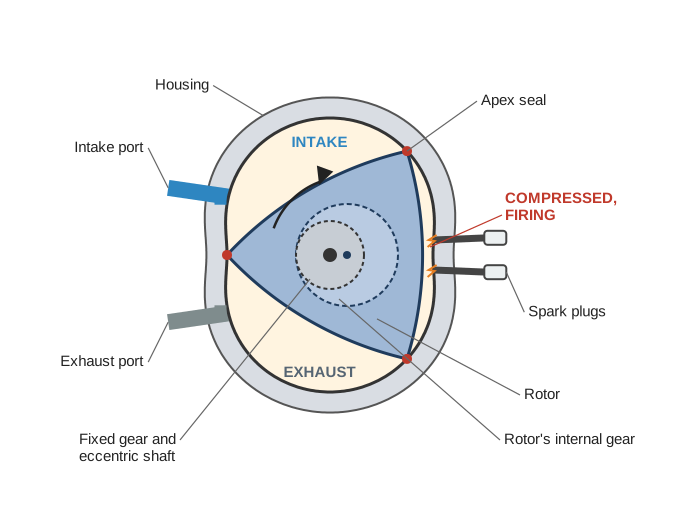
The housing. The inside of the housing has a shape called an epitrochoid: an oval pinched in at the waist on both sides. It is the path the rotor's three tips trace as it turns, so the tips stay in contact with the wall all the way round.
The rotor. The rotor is a triangle with curved sides. Each tip carries an apex seal that slides along the housing wall, and the three sides of the rotor divide the housing into three separate chambers. As the rotor turns, each chamber grows and shrinks twice per revolution.
The four strokes. Follow one chamber round the diagram. As it passes the intake port, its volume grows and it draws in air and fuel. Moving over the top, it shrinks, compressing the charge against the waist where the spark plugs sit. The plugs fire, the burning gas pushes on the rotor face, and the chamber grows again as it travels round the bottom. That is the power stroke. Finally, it reaches the exhaust port and shrinks to push the burnt gas out. All four strokes happen at once, one in each chamber, at any moment.
The shaft and gears. The rotor does not turn on the centre of the shaft. It rides on an eccentric lobe, so its centre moves in a small circle. An internal gear in the rotor rolls round a fixed gear on the housing with a ratio of 3:2, which keeps the tips on the wall and makes the shaft turn three times for every turn of the rotor. Each of the three rotor faces fires once per rotor turn, so the shaft gets one power stroke per revolution from every rotor.
Why It Is Different From a Piston Engine
What it does well. A Wankel has very few moving parts: in essence the rotors and a single eccentric shaft. Nothing changes direction, so it runs smoothly and revs freely, and it is compact and light for its power. That is why Mazda put it in sports cars.
What it does badly. The combustion chamber is long and thin and moves as it burns, which costs fuel and makes clean exhaust hard to achieve. The apex seals are the weak point: they wear, and when they fail the engine loses compression. And because the seals need lubrication, a Wankel injects a little oil into the housing and burns it by design.
A Short History
Felix Wankel developed the engine with NSU in Germany, and the first one ran in 1957. NSU put it into production in the Wankel Spider in 1964 and the Ro 80 saloon in 1967. Mazda launched the Cosmo Sport the same year and carried the rotary through the RX-7 and RX-8, and a Mazda 787B won the 24 Hours of Le Mans in 1991, the only win there for a rotary engine. The RX-8 went out of production in 2012. Mazda brought the rotary back in 2023, not to drive the wheels but as a generator in the MX-30 R-EV.
Choosing a Wankel Model
To understand how it works: the EISCO cutaway. You turn it yourself, slowly, and the lamp shows the firing point, which is exactly what you need to follow the cycle in the diagram above.
To build one: the Mould King brick kit, at 2,177 pieces, or the metal Wankel model for a smaller, quicker build in metal.
For a classroom: the 3B Scientific transparent model, made to be projected.
What About a Wankel That Really Runs?
Miniature rotary engines that burn fuel exist. Toyan makes the RS-S100, a single-rotor engine, and the RS-L200, a water-cooled twin-rotor of 4.92 cc. On October 1, 2026, both were sold out at every retailer we checked: Stirlingkit, Enginediy and Nikolatoy. We will add them here when they are back. Until then, for engines that burn fuel, see our best real working model engines and the Toyan engines guide.
More Engines to Explore
- Car engines in every layout: best visible engine model kits, best V8 engine model kits and best V12 engine model kits.
- Brick-built engines: best building block engine kits.
- Every kit we cover, in one searchable table: the model engine kit database.
What We Could Not Verify
We have not built these models. Their specifications come from the makers and the retailers that sell them:
- The EISCO model was checked against Eisco Labs' own product data on October 1, 2026.
- The metal Wankel model was checked against Enginediy's product data the same day. The listing does not say whether it is motorised.
- Amazon listings could not be read on October 1, 2026. We confirmed the Mould King and 3B Scientific models by their Amazon listing titles in search results, and took the 3B Scientific details from the maker. Check the live price and availability on each card.
- The Mould King kit's build time, size and age rating are not given in the sources we could read.
Detailed Reviews
EISCO Wankel Rotary Engine Model (PH0496)
A cutaway teaching model in aluminium and plastic: turn the crank and the rotor and shaft move as they do in a real engine, while a small lamp in the simulated spark plug lights at the firing point. A placard on the base names every key part. The model measures 8 × 7 × 3.5 in on an 8 × 8 × 2.5 in base. The lamp needs two AA batteries, which are not included.
Key Features
- Cutaway: rotor, housing and shaft visible
- Hand crank, no motor
- Spark plug lamp shows the firing point
- Labelled base, aluminium and plastic
- 8 × 7 × 3.5 in model on an 8 × 8 × 2.5 in base
Affiliate link — we earn a small commission at no extra cost to you
Mould King Rotary Engine (2,177 pieces)
A 2,177-piece building-block rotary engine with a motor, a battery box and a gearshift, sold as a kit that runs once built. The biggest build here, and the one to choose if you want to assemble a rotary engine piece by piece.
Key Features
- 2,177 pieces
- Motor and battery box included
- Gearshift
- Runs once built
Affiliate link — we earn a small commission at no extra cost to you
Metal Wankel Rotary Engine Model
A small Wankel model in metal and ABS that you assemble yourself from a detailed manual, with the rotor turning inside its housing to show intake, compression, ignition and exhaust in sequence. It comes in a gift box. The retailer does not say whether it is turned by hand or by a motor.
Key Features
- Metal and ABS
- Build it yourself from the manual
- 15 × 12.5 × 15 cm, 750 g
- Gift box
- Rated 14+
Affiliate link — we earn a small commission at no extra cost to you
3B Scientific Transparent Wankel Engine Model (U15600)
A flat, movable cutaway of a Wankel engine in 3–5 mm transparent acrylic, designed to be laid on an overhead projector so a whole classroom can watch the rotor move. Robust rather than decorative: the model for a teacher, not a shelf.
Key Features
- Transparent acrylic, 3–5 mm thick
- Movable function cutaway
- Made for an overhead projector
Affiliate link — we earn a small commission at no extra cost to you
Related Guides
10 Best Model Engine Kits to Build
Ten engine model kits worth building: snap-fit brick V8s, all-metal kits with moving pistons, and one real live-steam engine. Every pick checked September 2026.
Model Diesel Engines: Kits and a Real Running Diesel
Five model diesel engines compared, from an $89 resin engine for RC crawlers to TECHING's metal inline-four kit and the RETROL D16, a 16cc diesel that really runs on compression ignition. Checked October 2026.
Best Metal Engine Model Kits for Adults
Eleven metal engine model kits for adults, from a $149 pumpjack to a $1,099 V12, compared on parts, power, build time and age rating. Specs checked September 2026.
Our top pick
EISCO Wankel Rotary Engine Model (PH0496)