
How Stirling Engines Work
A Stirling engine runs on a temperature difference. Not on combustion inside a cylinder, not on steam pressure — just on the fact that a sealed pocket of gas pushes harder when it is hot than when it is cold. Understanding that one sentence, and the clever mechanism that exploits it, is the difference between owning an ornament and understanding a machine.
The Idea in One Paragraph
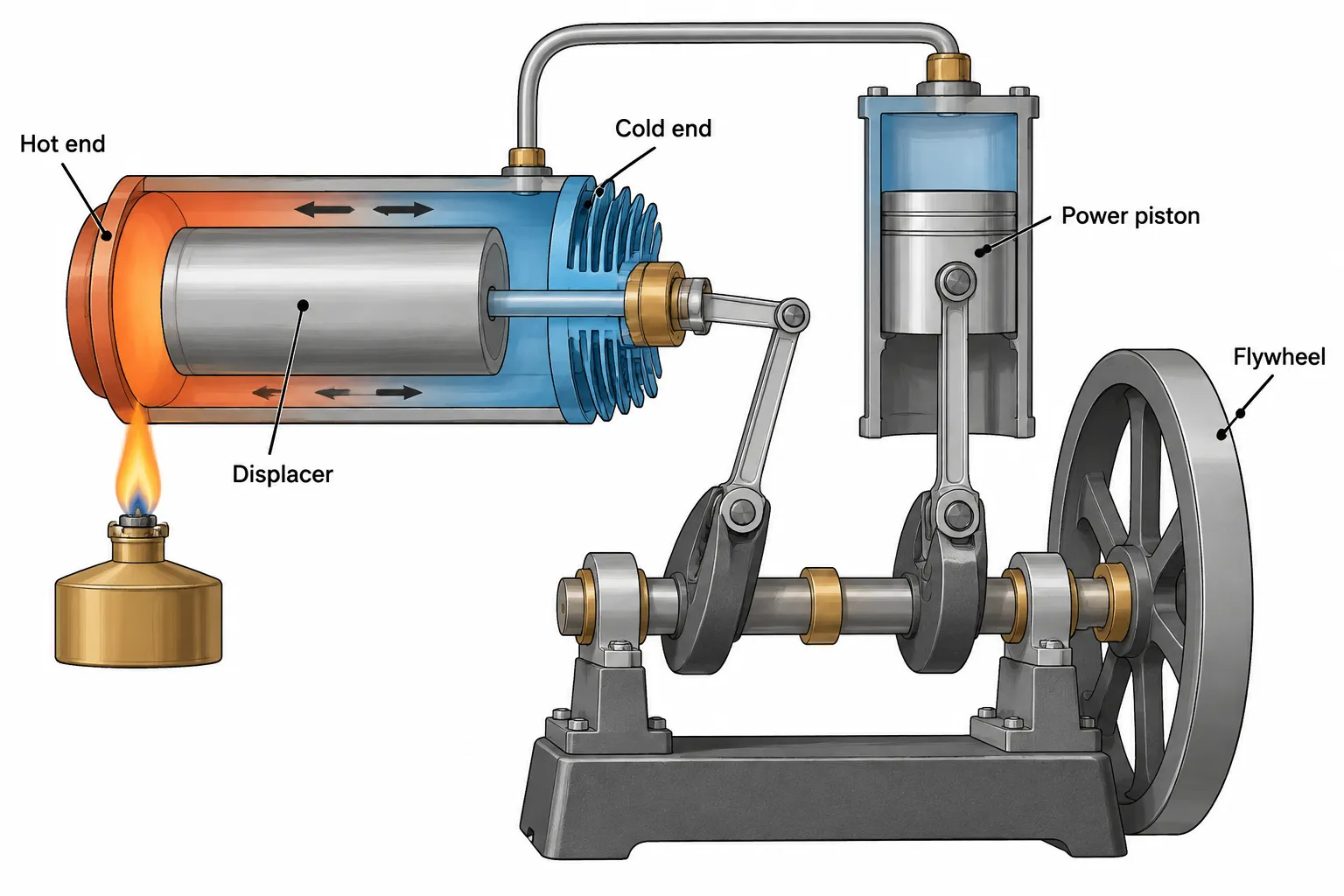
Seal a fixed quantity of gas inside an engine. Heat one end, cool the other, and shuttle that same gas back and forth between the two. When the gas sits at the hot end it expands and pushes a piston out. When it is moved to the cold end it contracts and lets the piston come back. Connect the piston to a crankshaft and a flywheel, and the engine runs — continuously, on nothing but the temperature difference between its two ends.
Nothing is burned inside. Nothing is exhausted. The same air goes round and round forever. That makes a Stirling engine a closed-cycle external combustion engine, and it is why the heat source is irrelevant: an alcohol burner, a candle, a mug of tea, sunlight, a radioisotope. The engine cannot tell the difference.
Robert Stirling patented it in 1816, partly as a safer alternative to the steam boilers of the day, which had an unfortunate habit of exploding and killing people.
The Displacer Is Not a Piston
This is the part that confuses almost everyone on first encounter, and it is the heart of the machine.
A typical Stirling engine has two moving elements in the gas circuit, and they do entirely different jobs.
The power piston is a real piston. It seals against its cylinder, and the pressure of the working gas acting on it is what produces the engine's output.
The displacer seals against nothing. It is a loose plug — often little more than a lightweight cylinder of steel wool, foam or thin metal — that is deliberately smaller than the bore it moves in. Gas flows freely around it. Its only purpose is to occupy space at one end of the chamber so the gas has to be somewhere else. Push the displacer toward the hot end, and the gas is forced into the cold end. Pull it back, and the gas fills the hot end instead.
So the displacer does not compress anything and it does not produce power. It just decides, moment by moment, whether the working gas is currently being heated or cooled.
The Ninety Degree Phase Angle
The displacer and the power piston are both driven from the same crankshaft, but offset by roughly 90 degrees. That offset is what turns the arrangement into an engine rather than a machine that fights itself.
The cycle runs like this:
- The displacer moves the gas to the hot end. The gas absorbs heat and its pressure rises.
- A quarter-turn later, the power piston is pushed outward by that pressure. This is the power stroke.
- The displacer moves the gas to the cold end. The gas gives up heat and its pressure falls.
- A quarter-turn later, the flywheel pushes the power piston back in against the now-reduced pressure — which costs less energy than step two produced.
The difference between the work extracted in step two and the work spent in step four is the engine's net output. Everything else is bookkeeping.
Get the phase angle wrong and the engine will not start in either direction. This is the single most common fault in a model that has been assembled slightly out of alignment.
The Regenerator
Stirling's 1816 patent included a component he called the economiser, and it is the reason his engine was more than a curiosity.
Every time the gas travels from the hot end to the cold end, it carries heat with it — heat that is then thrown away into the cooling fins. On the return trip the gas must be reheated from scratch. That is an enormous waste, repeated every revolution.
A regenerator is a thermal sponge placed in the gas path: a mesh, a wad of steel wool, or a stack of fine metal plates. Gas heading toward the cold end dumps its heat into the mesh on the way through. Gas heading back toward the hot end picks that heat up again. The burner then only has to supply what the regenerator could not store.
In a well-built engine the regenerator can transfer several times more heat per cycle than the burner does. It is the reason Stirling engines can approach the theoretical Carnot efficiency limit more closely than almost any other heat engine. On many small models the displacer itself, packed with steel wool, doubles as the regenerator.
Alpha, Beta and Gamma
Three standard layouts, distinguished by where the pistons live.
| Type | Arrangement | In models |
|---|---|---|
| Alpha | Two power pistons in two separate cylinders, one kept hot and one kept cold, cranks 90° apart. No displacer at all — each piston takes turns doing both jobs. | Used for multi-cylinder and V-configuration display models. Highest power density. |
| Beta | Displacer and power piston share one cylinder, mounted coaxially. The displacer passes through the power piston’s crown. | Compact and efficient, but the overlapping linkage is demanding to build. |
| Gamma | Displacer in one cylinder, power piston in another, connected so they share a single gas volume. | The great majority of model engines. Mechanically simplest, easiest to seal, most forgiving of imprecision. |
If you buy a model with a large horizontal glass cylinder and a small vertical one beside it, you have bought a gamma. The big cylinder is the displacer, the small one the power piston.
Low Temperature Differential Engines
The flat discs that spin on a cup of coffee or the warmth of a palm are LTD engines, and they are a distinct engineering problem rather than simply a small Stirling.
An LTD runs on a temperature difference of only a few degrees, sometimes less than five. To extract usable work from so little, everything has to be exaggerated in one direction:
- A very large diameter, very thin displacer chamber, to expose the maximum gas volume to the plates with the minimum distance to travel.
- An extremely light displacer, so moving it costs almost nothing.
- A low-friction power piston, often graphite in a glass cylinder, because friction that a burner-fired engine would shrug off will stop an LTD dead.
- A large flywheel relative to the power produced, to carry the engine through the dead points.
They will never drive anything. They exist to demonstrate that a few degrees of temperature difference is, in principle, usable energy — which is a more interesting thing to own than it sounds.
Why They Did Not Take Over the World
Stirling engines are quiet, fuel-agnostic, and theoretically very efficient. They also lost comprehensively to the internal combustion engine, for reasons worth understanding before buying one:
- Poor power density. All the heat must pass through a wall, and heat exchangers are bulky. A petrol engine burns fuel directly in the cylinder, which is thermodynamically messier but enormously more compact.
- Slow response. You cannot change the output of a Stirling engine quickly, because you have to change its temperature. That makes it unsuited to anything that accelerates.
- Sealing. Real efficiency needs pressurised helium or hydrogen, and keeping those in a machine with a reciprocating shaft is expensive.
They survive where those weaknesses do not matter: submarine air-independent propulsion, cryogenic coolers running the cycle in reverse, solar dish generators, and spacecraft power. And on desks, where being interesting is the entire specification.
What This Means When You Are Buying One
A few things follow directly from the mechanism:
- A stuck engine is usually friction or phase, not a fault. If it will not self-start, try flicking the flywheel both ways, check the displacer moves freely, and confirm the two cranks really are 90° apart.
- Glass cylinders are not decoration. Glass is smooth enough to run a graphite piston with no lubricant and almost no friction, which matters enormously on low-power engines.
- Cooling is half the engine. A model with generous fins or a water jacket on the cold end will run faster and longer than one that relies on ambient air, because the temperature difference is what produces power — not the temperature.
- An LTD and a burner-fired engine are not substitutes. One is a demonstration of sensitivity, the other of power. Decide which you actually want.
For specific models across these types, see our guide to the best Stirling engine models. If you enjoyed the mechanism here, the same external-combustion logic in a very different form is covered in types of steam engines.
Related Guides
Best Stirling Engine Kits and Models
Stirling engine kits you build yourself from $25, plus assembled models from a coffee-cup engine to a four-cylinder generator. Heat source, speed and what is in the box, checked September 2026.
Discovery MindBlown Model Engine Kit: What's in the Box and the Alternatives
What the Discovery MindBlown model engine kit actually contains, part by part, what each part does in a real engine, and four alternatives if your builder is older or wants more. Checked October 2026.
Model Diesel Engines: Kits and a Real Running Diesel
Five model diesel engines compared, from an $89 resin engine for RC crawlers to TECHING's metal inline-four kit and the RETROL D16, a 16cc diesel that really runs on compression ignition. Checked October 2026.