
Types of Steam Engines Explained
Steam engines are not one invention but a family of them, developed over 250 years as engineers solved one problem after another. This guide walks through every major type in the order it appeared, explains the mechanical idea behind each, and notes which designs survive today as working models you can actually run on a desk.
What Every Steam Engine Has in Common
A steam engine is an external combustion engine. The fire burns outside the working cylinder, heats water in a separate boiler, and the steam does the work. That single fact separates it from the petrol and diesel engines that replaced it, where the fuel burns inside the cylinder itself.
Because the heat source is external, a steam engine does not care what you burn. Coal, wood, oil, straw, nuclear fission — the engine is indifferent. That flexibility is why steam never truly disappeared: most of the world's electricity still comes from steam turbines spun by heat.
Every design below is a different answer to the same question: how do you turn the expansion of hot steam into useful motion with the least waste?
Atmospheric Engines — Newcomen, 1712
The first commercially successful steam engine barely used steam pressure at all.
Thomas Newcomen's engine filled a large cylinder with low-pressure steam, then sprayed cold water into it. The steam condensed, creating a partial vacuum, and ordinary atmospheric pressure pushed the piston down. A chain connected the piston to one end of a massive rocking beam; the other end lifted a pump rod in a mine shaft.
It worked, and for pumping water out of Cornish tin mines it was transformative. It was also appallingly wasteful. Heating and cooling the entire cylinder on every single stroke threw away almost all the energy — thermal efficiency was around half of one percent. Newcomen engines were only viable at coal mines, where the fuel was effectively free because it lay underfoot.
The Watt Beam Engine — 1776
James Watt's insight was deceptively simple: stop cooling the cylinder.
Watt added a separate condenser, a second chamber connected to the cylinder through a valve. Steam was drawn into the condenser and cooled there, while the working cylinder stayed hot all the time. The same amount of coal now did four to five times the work.
He kept improving it. The double-acting arrangement admitted steam alternately to both sides of the piston, so the engine pushed in both directions instead of only pulling. Sun-and-planet gearing turned the beam's rocking into rotary motion, which let steam drive factory machinery rather than just pumps. The centrifugal flyball governor held the speed steady as load varied — arguably the first widely used feedback control system in engineering.
The beam engine is the design most people picture when they imagine a Victorian engine house: a great cast-iron beam rocking slowly overhead, a flywheel the height of a room. It is also one of the most rewarding designs to own as a model, because the mechanism is entirely visible and moves slowly enough to follow with your eye.
Single-Acting and Double-Acting
This is a distinction that cuts across all the other types, so it is worth pinning down.
A single-acting engine admits steam to one side of the piston only. The power stroke goes one way; something else — a flywheel, gravity, or a return spring — brings the piston back. Simpler, but half the cylinder is doing nothing at any moment.
A double-acting engine seals both ends of the cylinder and admits steam alternately to each side. Every stroke is a power stroke. For the same cylinder size you get roughly twice the power, at the cost of a gland where the piston rod passes out through the cylinder end, which must seal against pressure.
Almost every serious stationary, marine, and locomotive engine is double-acting. Most small models are single-acting, because the gland is fiddly to make at that scale.
Oscillating Engines — the Simplest Design That Works
If you want the fewest possible moving parts, this is the answer, and it is the design behind most inexpensive model steam engines.
In an oscillating engine — often called a wobbler — the cylinder itself is not fixed. It pivots on a trunnion, and a spring holds its flat face against a fixed port block. As the crank turns, the cylinder rocks back and forth, and a port drilled in its face sweeps past the inlet and exhaust ports in the block. The cylinder is its own valve.
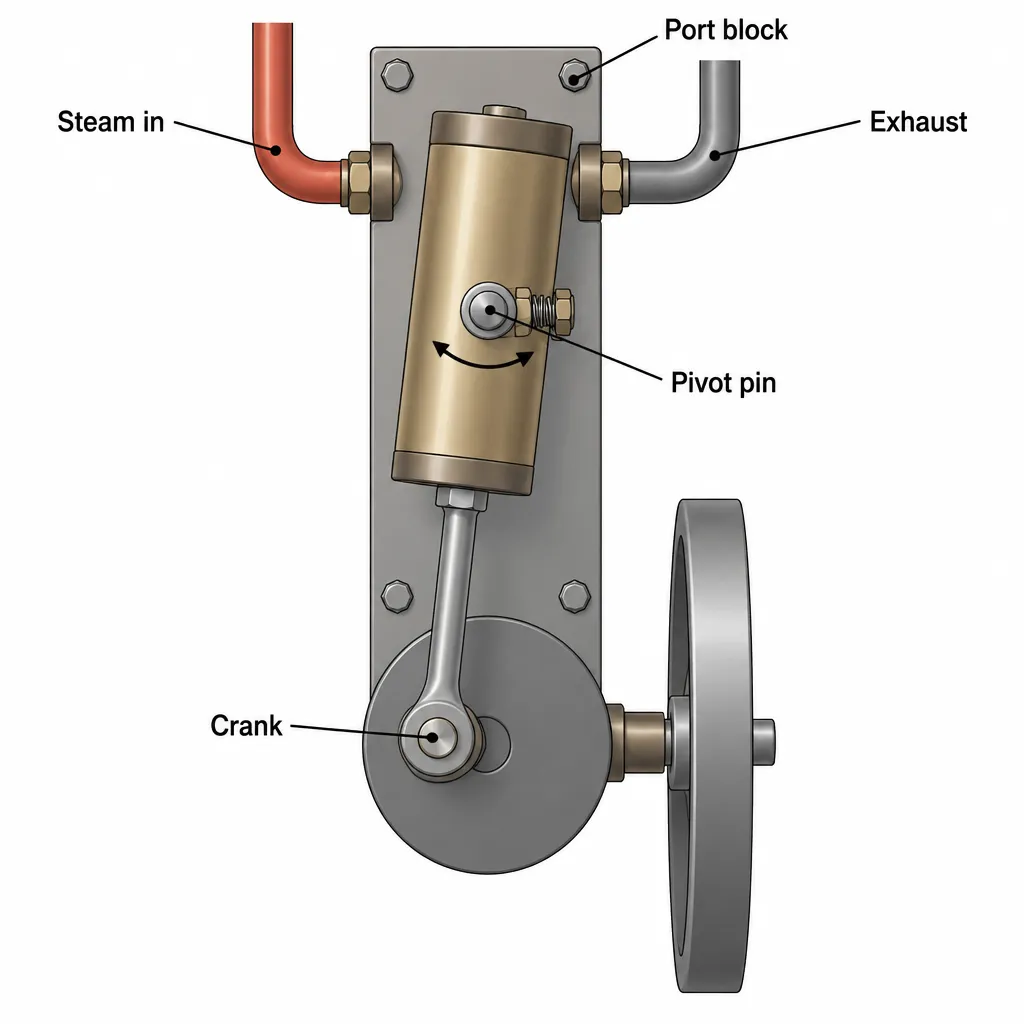
There is no valve gear, no eccentric, no slide valve, no pushrods. A working oscillating engine can be built from a handful of parts. That simplicity has a price: the timing is fixed by geometry, so you cannot adjust cut-off, and efficiency is poor. Nobody built a large oscillating engine for efficiency.
They were not only toys, though. Oscillating engines powered a good number of Victorian paddle steamers, where compactness mattered more than fuel economy.
If you are looking for the simplest steam engine that genuinely runs, this is it.
Slide-Valve Mill Engines
The workhorse of the industrial era. A horizontal (sometimes vertical) cylinder, double-acting, with a D-shaped slide valve driven by an eccentric on the crankshaft.
The eccentric is a disc mounted off-centre on the shaft. As the shaft turns, it pushes a rod back and forth, sliding the valve over a set of ports so that steam is admitted to one end of the cylinder while the other end exhausts. Set the eccentric's angle correctly and the valve leads the piston slightly, which is what makes the engine run smoothly and start reliably.
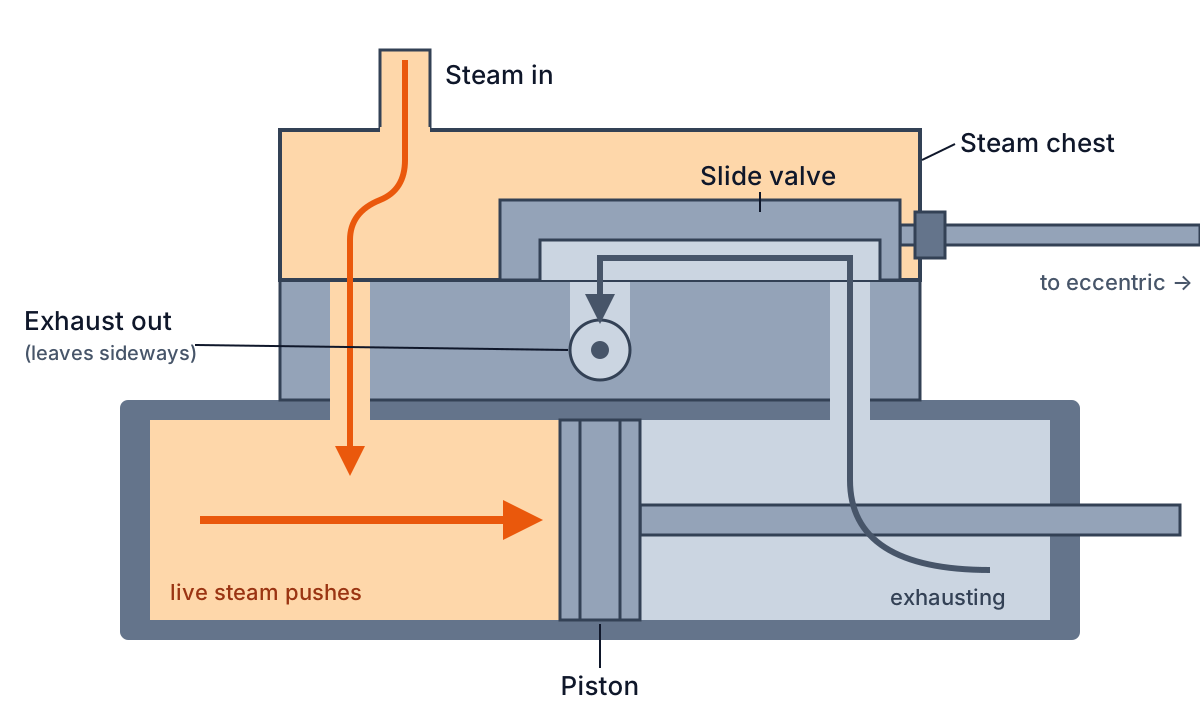
These engines drove textile mills, sawmills, machine shops and early generating stations, usually through a wide flat belt from a heavy flywheel. Most quality model steam engines — Wilesco, Jensen, and the better Chinese-made kits — use a slide valve for exactly the reasons the Victorians did: it is robust, self-adjusting under wear, and it works.
Compound and Triple-Expansion Engines
Here is the problem the compound engine solves. When high-pressure steam expands all the way down to exhaust pressure inside a single cylinder, the cylinder walls take a punishing temperature swing on every stroke — hot at admission, much cooler at exhaust. That cycling wastes heat, exactly as it did in the Newcomen engine, just less dramatically.
The fix is to expand the steam in stages. A compound engine sends high-pressure steam to a small cylinder, then routes its exhaust — still useful, just at lower pressure — into a larger second cylinder. Each cylinder sees a narrower temperature range. A triple-expansion engine does it three times, with a fourth stage on some large ships.
The cylinders get progressively bigger because the steam is less dense at each stage. That stepped arrangement of three or four cylinders of increasing diameter is the visual signature of a marine engine, and triple-expansion engines powered merchant shipping from the 1880s until well after the Second World War.
Compound models exist but they are advanced builds. You need accurate machining and good sealing at three different pressures for the engine to run at all.
Uniflow Engines
The last major refinement of the reciprocating steam engine, and the most thermodynamically clever.
In a conventional double-acting cylinder, steam enters and exhausts at the same end, so hot incoming steam meets surfaces that were just chilled by the exhaust. A uniflow engine admits steam through poppet valves at the hot ends of the cylinder and exhausts it through a ring of ports around the middle, uncovered by the piston itself at the end of its stroke.
Steam therefore always travels in one direction — uniflow — and each end of the cylinder stays permanently hot while the centre stays cool. No thermal see-sawing. Uniflow engines reached efficiencies that reciprocating steam had never managed before, right at the point when turbines and diesels were making the whole question academic.
They are rare as models. The piston has to be long enough to cover the exhaust belt, and the poppet valve gear is demanding work.
Locomotive Engines
A steam locomotive is a double-acting slide-valve engine adapted to a very particular set of constraints.
Two cylinders (sometimes three or four) are set with their cranks 90 degrees apart. That matters more than it sounds: with two cylinders at right angles, at least one is always positioned to produce torque, so the locomotive can start from a dead stand at any position. A single-cylinder locomotive could stop on dead centre and be stuck.
The exhaust does double duty. Rather than venting it quietly, the engine fires it up the chimney through a narrowing blastpipe. The jet of steam drags flue gas with it, pulling a fierce draught through the firebox. The harder the engine works, the harder it breathes — a self-regulating loop that makes the whole locomotive possible. The sound of that exhaust leaving the chimney four times per wheel revolution is the characteristic chuff.
Reversing and cut-off are handled by Walschaerts or Stephenson valve gear, which lets the driver change when in the stroke steam is cut off. Early cut-off means the steam expands more and uses less of it — the equivalent of short-shifting.
Steam Turbines
In 1884 Charles Parsons abandoned pistons entirely.
A steam turbine passes steam through alternating rows of fixed and moving blades. The steam does not push a piston back and forth; it flows continuously, giving up energy to each blade row in turn and spinning a shaft at very high speed. No reciprocating mass, no vibration, no valve gear, and no practical upper limit on size.
Parsons demonstrated the point in 1894 with Turbinia, which at 34 knots was the fastest vessel in the world. Within twenty years turbines had taken over large ships and power generation, and reciprocating steam engines began their long retreat.
This is the type that never went away. Coal, gas, nuclear and concentrated-solar power stations all boil water and put the steam through a turbine. When people say steam power is obsolete, they are talking about pistons, not steam.
Which Types You Can Buy as Working Models
| Type | Availability | Skill level |
|---|---|---|
| Oscillating (wobbler) | Very common, inexpensive | Beginner |
| Slide-valve horizontal/vertical | Common — Wilesco, Jensen, kits | Beginner to intermediate |
| Beam engine | Available as kits and RTR | Intermediate |
| Locomotive (live steam) | Available, expensive | Intermediate to advanced |
| Compound / triple-expansion | Rare, usually kits or castings | Advanced |
| Uniflow | Very rare | Advanced / scratch-build |
| Steam turbine | Rare, mostly demonstration toys | Beginner |
If you want to see the mechanism clearly, a beam engine or a slide-valve mill engine is the best choice — both run slowly enough that you can watch the valve events happen. If you simply want something that hisses into life in ten minutes, start with an oscillator.
For specific recommendations across these types, see our guide to the best steam engine models.
Which One Should You Build First?
Work up in this order, because each design teaches something the next one assumes you already understand:
- Oscillating engine. Learn what steam pressure feels like, how a boiler behaves, and why lubrication matters. Few parts, fast reward.
- Slide-valve mill engine. Now you meet valve timing and the eccentric. Getting the valve set right is the single most useful skill in model steam.
- Beam engine. Slow, visible, mechanically elegant — the linkage is the point.
- Live steam locomotive. Everything above, plus a real fire, working valve gear, and something that moves under its own power.
Skip ahead and you will spend your time debugging a machine whose principles you have not met yet. Steam is patient, but it is not forgiving of guesswork.
Related Guides
Best Model Steam Engines and Kits
Model steam engines that really run on steam: Wilesco's D10, D9 kit and D430 Locomobile, a live steam HO locomotive, a $69 oscillating engine and more. Boilers, fuel and run times, checked September 2026.
Discovery MindBlown Model Engine Kit: What's in the Box and the Alternatives
What the Discovery MindBlown model engine kit actually contains, part by part, what each part does in a real engine, and four alternatives if your builder is older or wants more. Checked October 2026.
Model Diesel Engines: Kits and a Real Running Diesel
Five model diesel engines compared, from an $89 resin engine for RC crawlers to TECHING's metal inline-four kit and the RETROL D16, a 16cc diesel that really runs on compression ignition. Checked October 2026.