
Turbojet vs Turbofan: What the Difference Means for Model Kits
Model jet engines are sold as turbojets, turbofans, twin-spool turbofans and turboshafts, often with the terms used interchangeably by the seller. They are not interchangeable — they are different machines solving different problems, and the differences are exactly what you will be looking at on your desk. Here is what separates them, and what the word 'working' means on a product that does not burn fuel.
The Common Core
Every engine on this page is a gas turbine, and they all share the same four stages, in the same order. Frank Whittle's phrase for it was suck, squeeze, bang, blow.
- Compressor. Rows of spinning blades squeeze incoming air to many times atmospheric pressure. This is most of the engine's length and most of its parts.
- Combustor. Fuel is sprayed into the compressed air and burned continuously — not in pulses like a piston engine, but as a steady flame.
- Turbine. The hot, high-pressure gas rushes through another set of blades and spins them. The turbine is connected by a shaft straight back to the compressor, which is what keeps the whole cycle self-sustaining.
- Nozzle. Whatever energy the turbine did not take is thrown out of the back.
The critical detail: the turbine's job is to drive the compressor. In the simplest arrangement it extracts just enough energy to do that, and everything left over leaves as a fast jet. What distinguishes the engine types below is how much energy the turbines take out, and what is done with it.
Turbojet
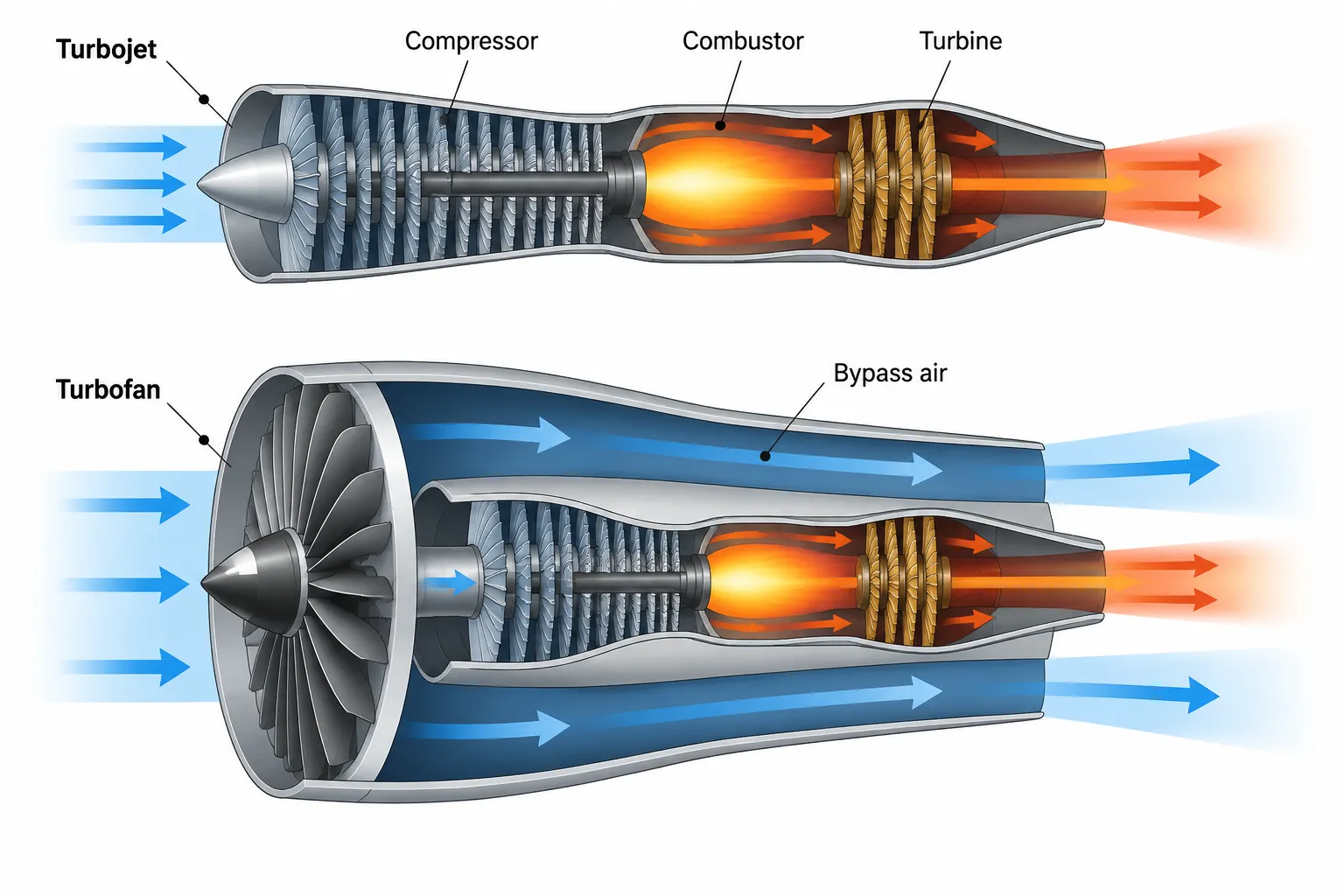
The original, and the simplest. All the air that enters the front goes through the core: compressor, combustor, turbine, nozzle. The turbine takes only what the compressor needs, and all the thrust comes from the high-speed exhaust jet.
That produces a small mass of air moving extremely fast. It is a thermodynamically valid way to make thrust, and it is also a loud and thirsty one at ordinary speeds — throwing a little air very hard is less efficient than throwing a lot of air gently, at any speed well below the exhaust velocity.
Turbojets dominated early jet aviation and still make sense above roughly Mach 2, where the incoming air is already moving fast enough that a high exhaust velocity is no longer wasteful. Below that, they have been replaced.
On a desk, a turbojet is the clearest possible illustration of the cycle, because there is exactly one air path and nothing hides it.
Turbofan
Put a large fan on the front and let most of the air it moves bypass the core entirely, flowing through a duct around the outside and rejoining the exhaust at the back.
The fan is driven by extra turbine stages at the rear, which extract far more energy from the hot gas than a turbojet's turbine does. The core becomes, in effect, an engine whose main job is turning the fan.
Bypass ratio is the number that describes this: the mass of air going around the core divided by the mass going through it. It is the single most informative specification on a turbofan.
| Bypass ratio | Where it is used | Character |
|---|---|---|
| 0 (turbojet) | Early jets, high-supersonic | Loud, thirsty below Mach 2, simple |
| 0.3 – 1 (low bypass) | Fighters, usually with afterburner | Compact frontal area, good at supersonic |
| 5 – 12 (high bypass) | Airliners | Quiet, efficient, very large diameter |
This is why an airliner engine looks like a huge ducted fan with a small engine buried inside it — because that is exactly what it is. On a modern high-bypass engine, the great majority of the thrust comes from the fan, not from the hot exhaust.
It also explains the shape of the models. A turbofan kit has a visibly larger front fan and a duct; a turbojet kit is a slim tube.
Twin-Spool
Look for this term on the better kits, because it describes a genuine mechanical sophistication rather than a marketing word.
A single-spool engine has one shaft: compressor, turbine and fan all locked together at the same speed. The trouble is that a big fan wants to turn slowly and a high-pressure compressor wants to turn fast, and you cannot have both.
A twin-spool engine uses two concentric shafts, one spinning inside the other:
- The low-pressure spool carries the fan and the low-pressure compressor at the front, driven by the low-pressure turbine at the back.
- The high-pressure spool carries the high-pressure compressor, driven by the high-pressure turbine immediately behind the combustor.
Each runs at the speed that suits it, and they are not mechanically linked — they settle at whatever relative speed the airflow dictates. Some large engines use three spools.
In a model, the twin-spool arrangement is the interesting part: two shafts turning at different speeds inside one another, visible through a cutaway. It is also why those kits have the highest part counts.
Turboshaft
A fourth variant that is often filed under "jet engines" and is not one.
A turboshaft extracts almost all the energy from the gas stream with its turbines and delivers it to an output shaft. There is barely any exhaust thrust left — that is the point. Helicopters use them to turn rotors; they also drive ships, tanks and power generators.
Mechanically it is a gas turbine with a free power turbine: a separate turbine stage, not connected to the compressor shaft at all, spinning only to drive the output. That allows the rotor to turn at a constant speed while the gas generator varies independently.
The TECHING T700 model reproduces the General Electric T700, the engine in the Black Hawk. If what appeals to you is the mechanism rather than the aviation, a turboshaft is arguably the most interesting of the four, because the free turbine is visible and is doing something distinct from everything in front of it.
What "Working" Means on a Model Jet Engine
This is the part that disappoints people who did not read carefully, so it is worth being blunt.
Model jet engine kits sold for desks do not burn fuel. There is no combustion, no flame, no fuel tank. An electric motor, usually USB-powered, spins the shaft, and the compressor, turbine and fan rotate exactly as they would in a real engine — driven from the wrong end.
That is not a defect, it is the only sane design. A real miniature gas turbine reaches temperatures over 700 °C, screams at a volume that would be unacceptable indoors, consumes kerosene, and costs several thousand dollars. Those exist, for model aircraft, and they are a different hobby with different safety requirements.
So what the desk models genuinely demonstrate is the mechanism: the blade geometry, the compression stages, the concentric spools, the airflow split between core and bypass. What they cannot demonstrate is the thermodynamics. Judge them on how faithfully the mechanism is reproduced and how much of it you can see, not on whether a listing uses the word "working".
Which One to Buy
Match the engine to what you actually want to look at:
- The clearest explanation of the jet cycle → a turbojet or a single-spool cutaway. One air path, nothing obscured.
- The most mechanically impressive → a twin-spool turbofan. Two shafts at different speeds, the highest part count, and the longest build.
- Something recognisably from an aircraft you know → a military low-bypass turbofan for a fighter, or a high-bypass one for an airliner.
- The most unusual → a turboshaft, where the free power turbine does something none of the others do.
For specific kits across all four types, see our guide to the best jet engine model kits.
Related Guides
Best Jet Engine Model Kits
Jet engine model kits from a $40 LED turbofan to TECHING's $999 twin-spool, plus a turboshaft, a turbojet and a real petrol pulse jet. Parts, scale, run time and build time, checked September 2026.
Discovery MindBlown Model Engine Kit: What's in the Box and the Alternatives
What the Discovery MindBlown model engine kit actually contains, part by part, what each part does in a real engine, and four alternatives if your builder is older or wants more. Checked October 2026.
Model Diesel Engines: Kits and a Real Running Diesel
Five model diesel engines compared, from an $89 resin engine for RC crawlers to TECHING's metal inline-four kit and the RETROL D16, a 16cc diesel that really runs on compression ignition. Checked October 2026.