
Building Block vs Metal Engine Kits: Which Should You Build?
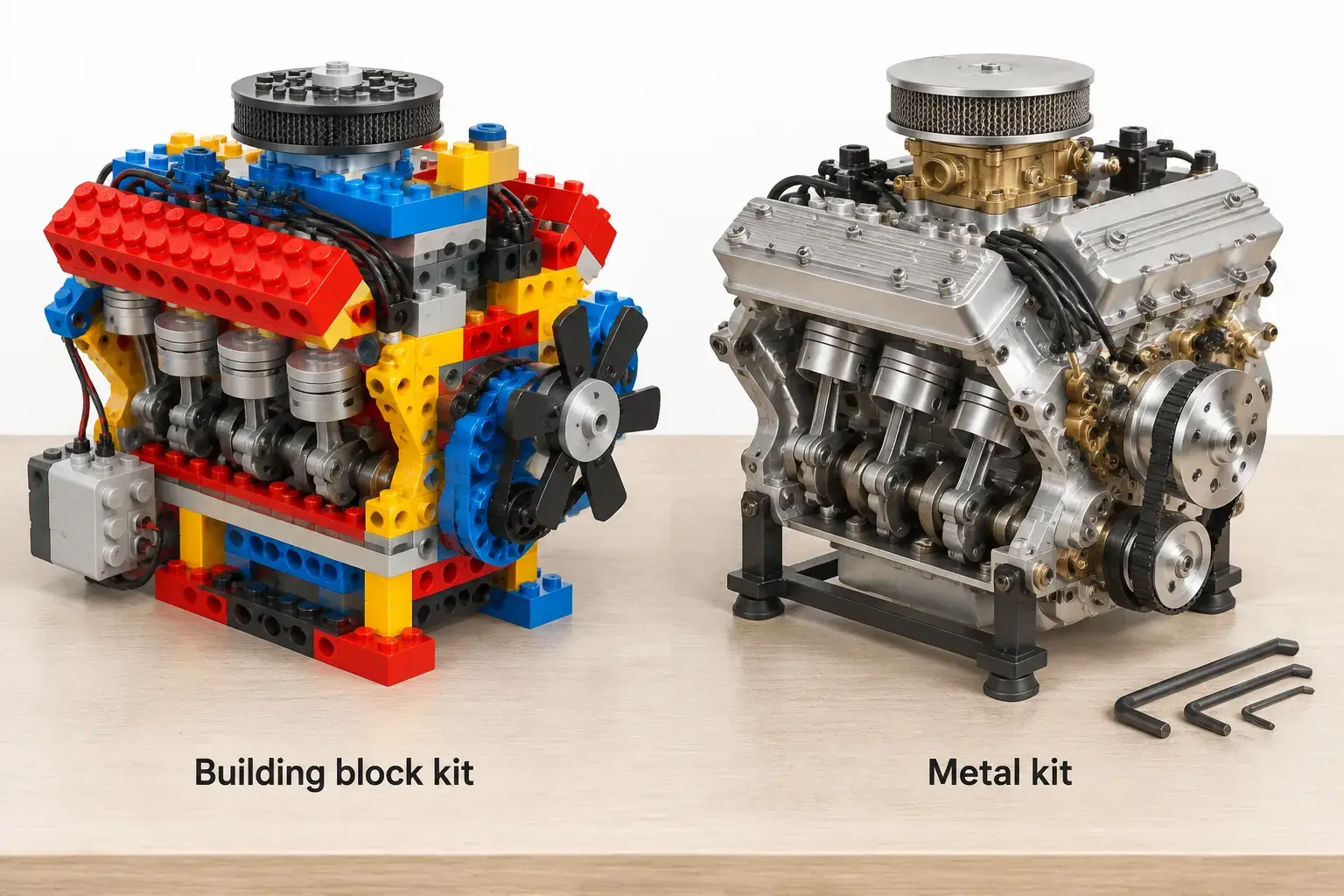
Two kits can both claim to be a V8 engine model with working pistons, and produce completely different afternoons. One snaps together from plastic bricks in a few hours and can be taken apart again; the other needs hex keys, thread-locker and patience, and when it is finished it is a small machine. Neither is the better choice in the abstract — but one of them is the better choice for you.
The Honest Summary
| Building block kits | Metal kits | |
|---|---|---|
| Assembly | Snap-fit, no tools | Screws, hex keys, sometimes thread-locker |
| Typical build time | 3–10 hours | 6–30 hours |
| Piece count | 300–3,000+ | 150–1,000 |
| Reversible | Yes, completely | In principle; rarely worth it |
| Can it fail? | Almost never | Yes — misalignment, seizing, stripped threads |
| What drives it | Small electric motor | Electric motor, or real fuel on some |
| Mechanism fidelity | Representational | Close to the real geometry |
| Suitable with children | Yes | Adult build, 14+ or 16+ |
| Display presence | Colourful, obviously a model | Looks like a machine |
What a Building Block Kit Actually Gives You
Brick engine kits are assembled from injection-moulded ABS pieces, usually compatible with the standard stud system, and driven by a small geared motor. The good ones reproduce the kinematics of an engine faithfully: pistons rise and fall in the correct firing order, the crankshaft throws are at the right angles, valves open and close in time with the camshaft, and on a V-engine you can see why a 90-degree vee balances the way it does.
What they cannot reproduce is anything that depends on precision or on real forces. There is no compression, no sealing, no combustion, and the tolerances are those of moulded plastic — parts must be loose enough to snap together by hand.
That is a real limit, and it is also not the point. A block kit is a moving diagram. For understanding firing order, valve timing and how a crankshaft converts reciprocating motion into rotation, a large brick V8 turning slowly on a desk is genuinely more legible than a metal kit, because everything is bigger and colour-coded.
They are also the only option on this site that works as a shared project with a child, and the only one where a mistake costs nothing but a minute.
What a Metal Kit Gives You
Metal kits are machined or cast components — aluminium, brass, steel — fastened with real screws to real tolerances. Building one is closer to assembling a machine than to following a model kit's instructions.
The differences you will notice within the first hour:
- Fit is exact, and therefore unforgiving. A part that goes in slightly crooked will bind rather than snap into place with a shrug.
- Order matters permanently. Miss a washer inside the crankcase and you are taking the crankcase apart again.
- Torque matters. Overtighten into aluminium and you strip the thread; undertighten and it works loose once it runs.
- It can fail to work at the end. A kit that binds usually has one identifiable cause — a misaligned bearing, a burr, an over-tightened cap — and finding it is part of the exercise. This is the single biggest difference from a block kit, where the finished model always works.
In exchange you get something that is mechanically real. On the running engines, real means real: fuel, compression, heat and exhaust, as covered in our guide to running a miniature IC engine.
Choosing by What You Want Out of It
Pick a building block kit if:
- You want a satisfying build with a guaranteed result
- Someone under about twelve is helping
- You want to understand engine layout — firing order, valve timing, V versus inline
- You may want to disassemble and rebuild it
- You have no tools and no interest in acquiring any
Pick a metal kit if:
- You want the finished object to look and feel like a machine
- Troubleshooting a bind is a feature and not a ruined evening
- You want the option of an engine that actually runs on fuel
- You have or want hex keys, thread-locker, light oil and a clear bench
- You are prepared to lose a Saturday
The Traps in Each
Building block kits. Piece count is marketing more often than difficulty — a 2,000-piece kit made mostly of small repeated panels is easier than a 600-piece kit with a complex valvetrain. Check whether the motor is included, because it frequently is not, and check that the pieces are genuinely brick-compatible if that matters to you. Very large builds become fragile to move once assembled.
Metal kits. Confirm whether it is a display model, an electrically driven runner, or a true combustion engine, because all three are sold with the word "working". Check what is not in the box: fuel, oil, batteries, ignition and starters are often extra. And read the difficulty rating honestly — a first metal kit should not be a twin-spool turbofan or a 14cc four-cylinder.
A Reasonable Order
If you want both eventually, this sequence wastes the least money:
- A mid-size building block engine. Learn the layout with no risk.
- A small metal display kit. Meet real fasteners and tolerances on something that does not need to run.
- An electrically driven metal engine — a turbofan or a multi-cylinder. Precision now matters, but nothing burns.
- A running combustion engine. Everything above, plus fuel, ignition and heat.
Skip straight to step four and you will probably get there. You will also spend the first weekend learning, under pressure, the things steps two and three teach cheaply.
For specific kits, see our guides to the best building block engine kits and the best metal engine model kits.
Related Guides
Best Building Block Engine Model Kits
Fourteen brick-built engine kits compared, from a 564-piece turbojet to Mould King's 3,089-piece radial: V8s, V6, V12, inline-six, diesel, radials and a tank engine. Pieces, motor and age, checked September 2026.
Discovery MindBlown Model Engine Kit: What's in the Box and the Alternatives
What the Discovery MindBlown model engine kit actually contains, part by part, what each part does in a real engine, and four alternatives if your builder is older or wants more. Checked October 2026.
Model Diesel Engines: Kits and a Real Running Diesel
Five model diesel engines compared, from an $89 resin engine for RC crawlers to TECHING's metal inline-four kit and the RETROL D16, a 16cc diesel that really runs on compression ignition. Checked October 2026.