
How Hit-and-Miss Engines Work
A hit-and-miss engine keeps a steady average speed by the crudest method imaginable: when it is going fast enough, it simply stops firing and coasts. That single design decision explains the distinctive pop… clunk-clunk-clunk… pop rhythm, the enormous flywheels, the open water hopper, and why these engines are so satisfying to watch. Here is the mechanism in detail.
The Problem These Engines Were Built to Solve
An engine driving a water pump on a farm in 1905 faces a specific difficulty. The load is not constant — it rises and falls as the pump works — but the engine needs to hold a roughly steady speed regardless. Run too fast and you destroy the machinery; too slow and the pump stalls.
A modern engine solves this by varying how much mixture it takes in per cycle. Press the accelerator, the throttle plate opens, more charge enters, more power comes out. That requires a decent carburettor and a throttle linkage — both of which were expensive and unreliable on a cheap farm engine of that era.
The hit-and-miss engine takes the opposite approach. It never varies the size of the charge. Instead it varies how often it fires. Every firing stroke is a full-power stroke; the engine just skips the ones it does not need.
The Governor and the Latch
The mechanism has three parts working together.
The flyball governor. Two weights are mounted on arms driven by the crankshaft, usually spinning inside one of the flywheels or on a gear-driven side shaft. Centrifugal force throws them outward against a spring as speed rises, and they fall back inward as speed drops. The governor's only job is to convert engine speed into the position of a small rod or collar.
The latch. When speed exceeds the setpoint, that rod pushes a latch — often a simple pivoting finger or wedge — into the path of the exhaust valve linkage. The latch catches the exhaust valve lever as the cam releases it and holds the exhaust valve open instead of letting it close.
The atmospheric intake valve. This is the part most explanations leave out, and it is the reason the trick works. On a typical hit-and-miss engine the intake valve has no cam at all. It is a light poppet held shut by a weak spring, and it opens purely from suction — when the piston descends and creates a vacuum in the cylinder, atmospheric pressure pushes the valve open and the charge flows in.
Now put those together. With the exhaust valve latched open, the descending piston cannot create any vacuum; it just draws exhaust gas back in through the open valve. No vacuum means the atmospheric intake valve never opens, so no fresh charge enters. On the way back up, whatever is in the cylinder is pushed straight back out of the still-open exhaust valve. No compression. Nothing to ignite.
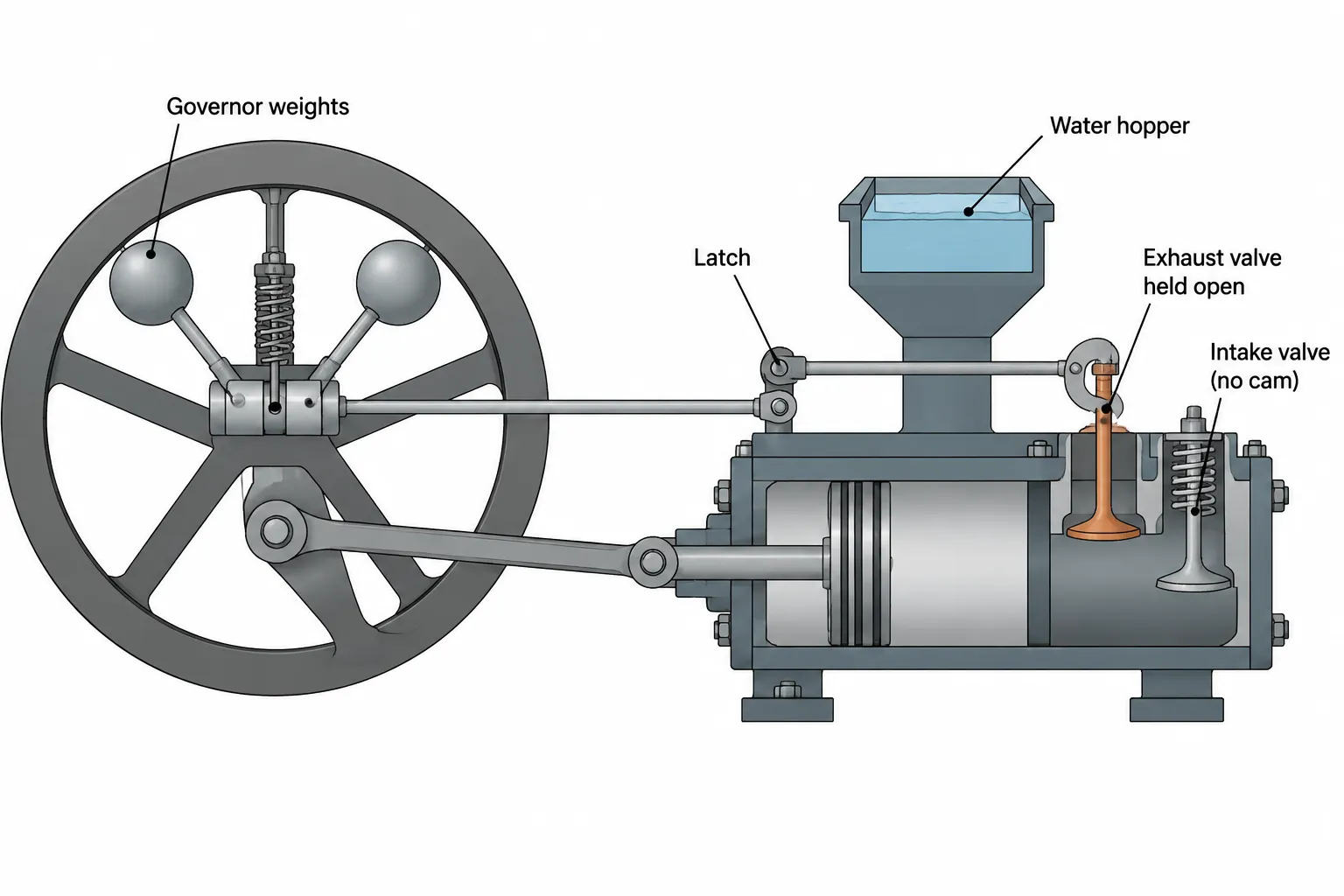
The engine is now a very heavy air pump, coasting on flywheel momentum. Those are the miss cycles.
As momentum bleeds away and speed falls below the setpoint, the governor weights drop inward, the latch withdraws, and the exhaust valve closes normally on the next cycle. The piston descends, vacuum forms, the intake valve pops open, a fresh charge enters, gets compressed, and fires. That is the hit — one full-power stroke that spins the flywheels back up to speed, at which point the governor latches the valve out again and the whole cycle repeats.
Reading the Sound
Once you know the mechanism, the noise becomes legible.
The sharp bark is the firing stroke. The series of softer metallic clunks that follow is the valve gear continuing to run through its motions while the exhaust valve sits latched open, the piston pumping air back and forth, the flywheels carrying the engine round.
Under light load, the flywheels hold speed for a long time, so you get one pop and a long stretch of clunking — sometimes ten or fifteen revolutions between firings. Put the engine to work and it fires far more often; under heavy load a hit-and-miss engine will fire nearly every cycle and sound almost like a conventional engine.
That is the diagnostic worth knowing: firing frequency is a direct readout of load. Listening to one of these engines tells you exactly how hard it is working.
Ignition: Make-and-Break and Spark Plugs
Early hit-and-miss engines did not use spark plugs. They used a make-and-break igniter: two electrodes projecting into the combustion chamber that are physically touching, then snapped apart at the moment of ignition by a trip mechanism driven off the cam. Breaking the contact under current draws an arc directly in the mixture.
The current came from a low-tension magneto or a dry-cell battery and coil. The system has the advantage of being almost impossible to foul — the electrodes wipe themselves clean every time they make contact — which mattered on engines running on kerosene and poorly filtered fuel.
Later engines moved to a spark plug fired by a high-tension buzz coil or magneto, which is the arrangement almost all modern model engines copy. Some premium models reproduce a working igniter, and it is worth seeking out if authenticity matters to you.
Hopper Cooling
Look at the top of a classic hit-and-miss engine and you will see an open cast-iron tank sitting over the cylinder. That is the water hopper, and it is the entire cooling system.
There is no pump, no radiator, no fan and no thermostat. Water sits in a jacket around the cylinder, absorbs heat, and boils off as steam. The operator tops it up from a bucket. Running an engine dry will damage it, and watching the hopper is part of running one.
It sounds primitive, and it is, but it has a real advantage: water boiling at 100 °C holds the cylinder at a stable, known temperature no matter how hard the engine works, because the phase change absorbs enormous amounts of heat. Better models reproduce evaporative hopper cooling faithfully, and steam genuinely rises off them while they run.
Why the Flywheels Are So Large
Two reasons, and both follow from the governing method.
First, a hit-and-miss engine must coast through many non-firing cycles without dropping below its setpoint. The energy to do that has to be stored somewhere, and it is stored as rotational inertia in the flywheels.
Second, a single-cylinder four-stroke gets one power stroke every two revolutions even when firing continuously. Without significant flywheel mass the engine would lurch rather than turn.
Most of these engines carry two flywheels, one on each side of the crankshaft, frequently 60 cm or more across on a full-size engine, and they doubled as belt pulleys for driving machinery.
What They Actually Powered
Hit-and-miss engines were general-purpose farm power from roughly the 1890s to the 1930s, in the gap between animal power and rural electrification. A single engine on a cart or skid was belted to whatever needed driving that day: water pumps, corn shellers, feed grinders, cream separators, washing machines, saw rigs, small generators.
Typical running speeds were 300 to 600 rpm — slow enough that every part of the cycle is visible to the naked eye, which is a large part of why they are so compelling to watch now.
Why Throttle Governing Eventually Won
Hit-and-miss governing is excellent for steady, moderate loads and terrible at anything else. Power delivery is inherently lumpy, response to a sudden load change is slow, and the whole approach wastes the opportunity to run at partial charge. It also caps power density: you cannot get more out of the engine than its full-charge stroke provides, no matter how often you fire.
As carburettors and ignition systems became cheap and reliable, throttle governing took over everywhere, and it is what every petrol engine has used since. Hit-and-miss survives only as a thing people restore and admire — which is precisely why the models exist.
What to Check Before Buying a Model
Understanding the mechanism gives you one specific thing to look for, and it separates the good models from the decorative ones.
Does the governor actually latch the exhaust valve? On a faithful model, the flyweights visibly swing out at speed and a latch engages the exhaust valve lever, and the engine genuinely skips firing cycles under light load. On a cheaper model the governor is present but decorative — it spins, and nothing downstream of it does anything.
Two further points worth checking:
- Cooling type. An evaporative hopper that actually steams is far more convincing than a sealed dummy tank, and it tells you the model is built to run rather than to sit.
- Ignition. A working make-and-break igniter is the authentic arrangement for an early engine; a spark plug with CDI is easier to live with and starts more reliably. Neither is wrong, but know which one you are buying.
A model that reproduces the latch mechanism will give you the real pop-and-coast rhythm on a desk. One that does not is an engine that happens to be shaped like a hit-and-miss.
For models that get this right, see our guide to the best hit-and-miss engine models.
Related Guides
Best Hit-and-Miss Engine Models
Miniature hit-and-miss engines that really run on petrol, from a $279 oddball to Retrol's 7cc HM-01 kit and the Retrol & OKMO range. Displacement, cooling, starting and what comes in the box, checked September 2026.
RETROL & OKMO N01: A 3.6cc Vertical Hit-and-Miss Engine
RETROL and OKMO's N01 is a 1/5-scale 3.6cc vertical hit-and-miss engine, ready to run, with evaporative hopper cooling and trigger-fired ignition. Full specifications, how it compares to the existing field, and the one thing the spec sheet does not tell you.
Discovery MindBlown Model Engine Kit: What's in the Box and the Alternatives
What the Discovery MindBlown model engine kit actually contains, part by part, what each part does in a real engine, and four alternatives if your builder is older or wants more. Checked October 2026.